
Searching Coke County Criminal Dockets
Pull the caption off whatever paper you already hold. A notice, bond, citation, or signed order will name the court. That name decides your next move. The Coke County iDocket calendar gives the public free filters for the County Court and 51st District Court. It works well for upcoming settings. It is not a complete criminal docket, though. The case-number link stops at a subscriber sign-in. So an empty calendar does not mean no case exists.
Try the exact cause number first. Without it, hand the clerk a full name, the likely court, and a tight range of filing years. The official re:SearchTX portal is another route, offering hearings, some documents, and case data from participating courts. Criminal coverage varies by court and case, so treat it as one tool among several.
- Read the court name and cause number from an official paper.
- Check iDocket for a future County Court or district setting.
- Try re:SearchTX and confirm Coke County coverage.
- Call or visit the proper clerk if public systems fall short.
- Request the exact public document and copy type needed.
Coke Criminal Calendar Limits
The free Coke County court calendar lets the public filter by date range, court, case number, and attorney. A result typically shows a hearing description plus the date, time, court, and location. That answers a scheduling question and nothing more. It is not a full account of pleadings, bond events, judgments, or money entries. A hearing label never proves what happened in the courtroom.
The official 51st District Court page names Coke County's district court. It also gives the local coordination route.
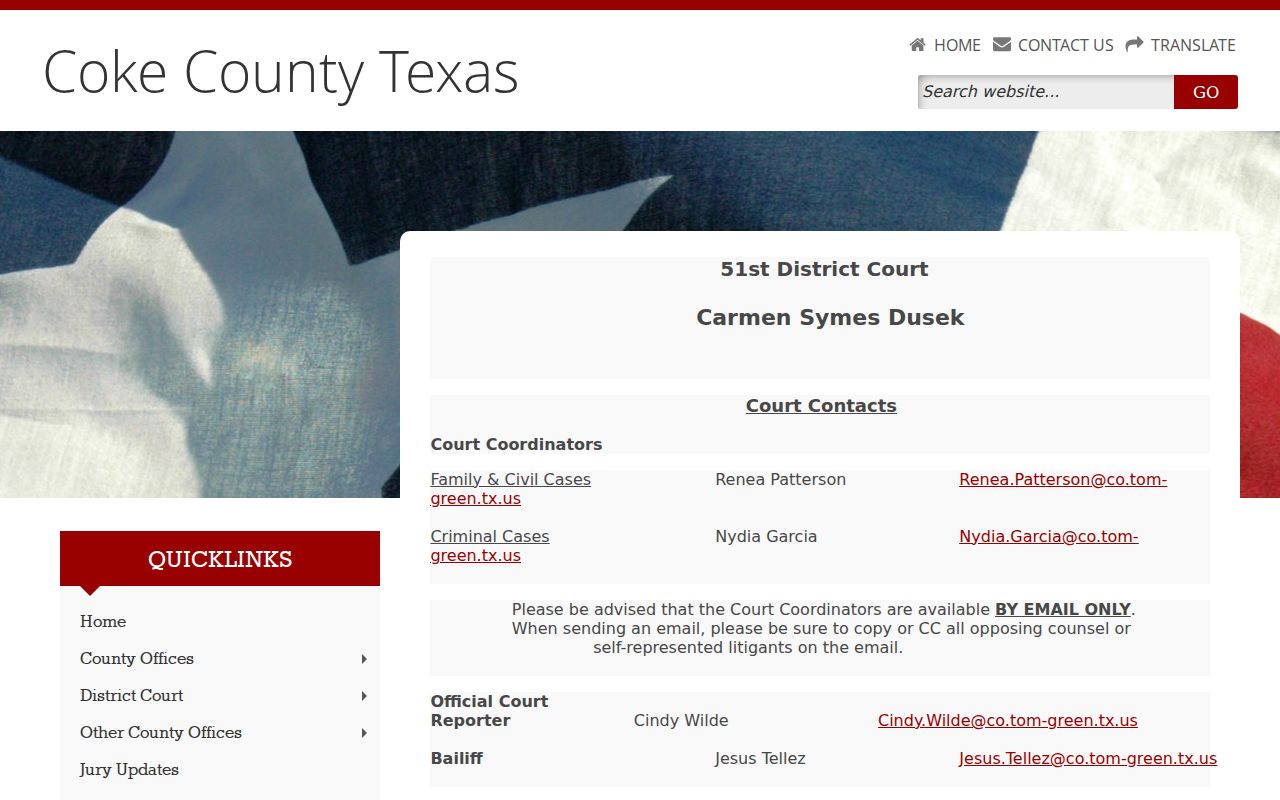
Confirming the district court is where that page helps most before any criminal docket search. It also points you back to the named court for hearing instructions, so a calendar label never gets the final word.
Inside a Coke County Criminal Docket
Think of a criminal docket as a dated log of activity. It is not the case file itself. Public entries can name the court, cause number, offense level, charging paper, counsel, settings, motions, orders, judgment, sentence, or appeal. Bond and release details may show up when they are public. Which fields appear depends on the court system. Its access rules play a part too.
| Cause number | The court identifier used to match calendar, clerk, and statewide records. |
|---|---|
| Charge entry | A complaint, information, or indictment when public. |
| Setting | An arraignment, motion hearing, pretrial, plea, trial, or sentencing date. |
| Filed action | A motion, order, notice, attorney appearance, or transfer. |
| Disposition | The recorded judgment, dismissal, plea result, verdict, or final act. |
Read every field in context. A warrant reference is not a judgment. An arraignment date proves no guilt. When you need formal proof of outcome, ask the clerk for the judgment or a certified copy of the recorded result.
Coke Settings Are Not Dispositions
A hearing description shows what was set, not what occurred. The matter may be reset, continued, dismissed, resolved by plea, or taken under advisement. "Continuance" means the court pushed a proceeding to a later date. "Disposition" means the recorded outcome. The two terms are not interchangeable.
- Arraignment
- A proceeding where the charge is stated and a plea may be entered.
- Pretrial setting
- A scheduled event before trial, often used for motions or case status.
- Reset
- A later date assigned after a prior setting changes.
- Disposition
- The docketed result, checked against the signed judgment.
Filing → Arraignment → Pretrial → Plea or Trial → Disposition → Sentencing is a common reading order, but a Coke County case may repeat or skip steps. The signed, filed order controls over a short calendar label.
How a Criminal Case Moves
A district felony usually starts with a charging process. It then runs through arraignment, pretrial work, and a plea or trial. County misdemeanors travel the county-level docket. Class C cases stay with the JP or municipal court unless a lawful appeal changes the route. Each stage can add a date, filing, or order to the Coke County criminal docket.
Motions can deal with evidence, scheduling, counsel, or other issues. A plea setting does not guarantee a plea happened. Trial entries may include jury events and later sentencing. If an appeal is filed, write down the trial cause number and check the Third Court of Appeals. The trial clerk still keeps the underlying local record.
Courts That Hold Criminal Dockets
Several offices hold criminal dockets in Coke County. The Texas trial-court overview explains broad jurisdiction rules, but the charging paper or citation tells you the actual court. A multi-county court can put the hearing place in one county and the Coke County record request in another.
| Case level | Court | Starting contact |
|---|---|---|
| Felony | 51st District Court | County/District Clerk |
| Class A or B misdemeanor | Coke County Court | County/District Clerk |
| Class C or citation | JP Precinct 1 or municipal court | Issuing court |
| Federal offense | Northern District, San Angelo Division | PACER or federal clerk |
The combined clerk sits at 13 E. 7th Street in Robert Lee, phone (325) 453-2631. JP Precinct 1 is at 224 W. Main Street in Bronte, phone (325) 473-2323. Municipal cases from Robert Lee and Bronte go to each named city court.
Coke Felony Venue and Records
The 51st District Court spans five counties. Its primary listed courtroom sits at the Tom Green County Courthouse, 112 W. Beauregard Avenue in San Angelo. Even so, the Coke County/District Clerk stays the local record contact for Coke filings. That split can catch you off guard. Do not expect the counter and the hearing room under one roof.
For hearing questions, the official district court page lists criminal coordinator Nydia Garcia. It also lists an email-only protocol. It asks correspondents to copy opposing counsel or any self-represented parties. Use that route for coordination, never for private argument. Follow the actual notice and signed orders.
Note: Confirm both the courtroom and the record custodian before you travel. A Coke filing may have a San Angelo setting.
Certified Coke Criminal Dispositions
A docket result on a screen proves nothing by itself. If you need the official outcome for a legal purpose, go to Carolla Orcutt’s County/District Clerk office. Request the actual judgment, order, or disposition. Say whether you want a plain copy or a certified one. Give the court, the cause number, and the document title. Add a close date range so the clerk can find it fast. The official clerk page posts contact details and the forms you need.
Costs come from a posted Coke County fee schedule dated 2024. That schedule is not a current quote. It lists a $5 name search when no docket number is supplied. Page-based copy charges and $5 certification also appear. Texas Government Code Chapter 51 can govern district-clerk fees. Call ahead to confirm cost and delivery before you order anything.
Sealed Dockets and Public Access
Not everything in a Coke County court record is open to the public. Juvenile records can stay confidential. A cause-number stub appearing on some other portal does not make sealed material public. It does not expose protected identifiers either. Texas filing rules shield Social Security and tax numbers, financial accounts, birth dates, home addresses, license or passport numbers, and the names of minors.
Key access rules:
Texas Rule of Judicial Administration 12 governs judicial records within its defined scope, not every case-file dispute.
Texas Family Code Chapter 58 limits access to juvenile records.
Texas Government Code Chapter 51 addresses district-clerk duties and fees.
Public information requests: a county public-information form cannot override a court sealing order or juvenile law. Ask for the public version of the specific document you want, and give the clerk room to make any required redactions.
No Coke Criminal Docket Result
A blank Coke County criminal docket search can mean several things. The court may be wrong, or the name may be spelled differently. The date range may be too narrow, or the coverage incomplete. A new filing might simply lag, or a lawful restriction may block the record. No match never proves a matter did not exist. Recheck the cause number and court name, then ask the right clerk whether a public record exists.
The right office depends on the charge. For a municipal or JP citation, contact the issuing court directly. For a federal caption, use PACER and the Northern District of Texas, San Angelo Division. County activity reports only count workloads, so they cannot identify a person or prove a case result.
Custody decides your fallback. The combined County/District Clerk holds County Court and 51st District Court records locally. The Justice of the Peace and each municipal court keep their own lower-court files. A written request should name the exact charge document, judgment, order, or setting. Do not ask for everything tied to a name. Transcripts run through the court-reporter process, not the clerk’s copy desk. The district page lists Cindy Wilde as official court reporter.
One more caution. When a case-number link stops at a subscriber sign-in, write down the cause number. Then call the clerk before you pay for access. Ask if in-office inspection is possible. Ask whether the record is scanned or archived, and what the current copy charge is. The county does not promise a public docket terminal, so confirm that option before driving to Robert Lee.